Tuesday, February 8, 2011

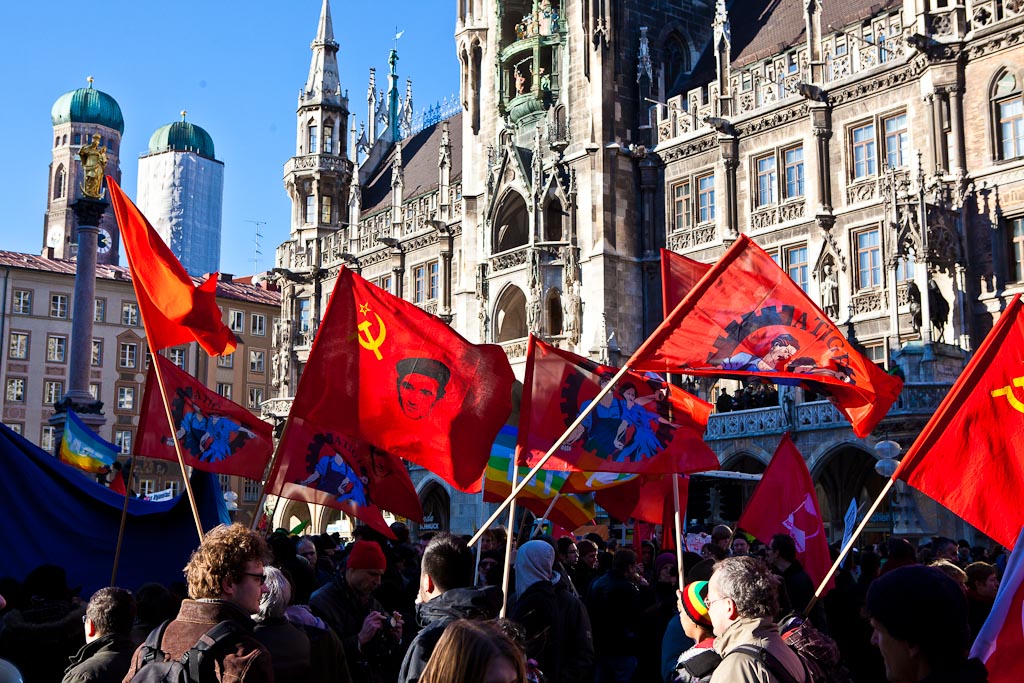
5th February - Demo Day

Since I recovered from my massive fug over Christmas when I avoided my camera I am back on form and really enjoying myself again.  One form of photography I enjoy is working in and around parades or demos.  Last year I used the Christopher Street parade for one of my assignments in People and Place.

http://sclarke-people-and-place.blogspot.com/2010/08/assignment-2-submission.html

This year I will return and shoot again, planning a little better than I did last time.  This weekend was a different type of event, the NATO security conference was in town in Munich.  The event draws many world leaders, David Cameron was there, as well as Hillary Clinton.  This inevitably draws protest and this year was no different.  I did not have much time to photograph, so grabbed a few quick shots in which I tried to capture the colour of the event.

Before arriving at the main demo in the cities central square I passed a smaller group showing solidarity to the Egyptian crisis:


I was especially taken by the little boy with his Mubarek must Leave message.

Other than this I concentrated primarily on the colour and form of the flags and banners carried by the different protesting groups in the city center:


No comment other than to record photographically a colourful and peaceful day - the guys above were not needed.

Assignment 2: Lower Light

After a brilliant bright sky weekend, I opted to return to the Hypohaus and the other office buildings in Arabellpark just before sunset to capture the changing light and explore the opportunities that the changing light would bring.  This time I took a single lens and camera, my 5D2 full frame paired with a 70-300 IS zoom, still focusing on detail and abstraction, but this time no trees, or at least not intentionally.

Approaching the banks, I used the telephoto at its full extension of 300mm to capture the following photograph that heavily compresses the buildings, creating another almost abstract image:


For this photo set my goal was primarily to capture more details of the Hypohaus and show the changing light.  I was surprised by the degree to which the change was obvious.  I left the camera on auto-WB and shot the following two frames about 25 minutes apart.


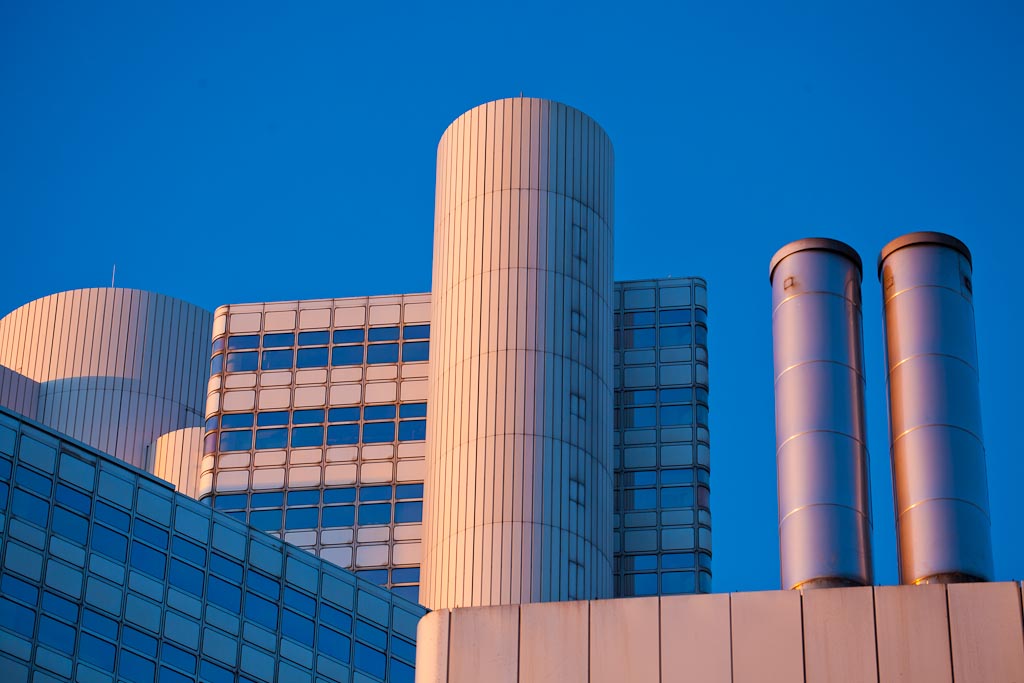
Aside from the obvious change in perspective due to my being very much closer to the building for the second shot the change in colour is spectacular.  Processing these images I have refrained from pushing the colour, just increased the contrast a little.  As the building is covered in silver metallic panels the building colour changes with the colour of the light being reflected, creating a powerful golden sheen as the sun fell.

The next 3 images are close ups looking for interesting geometries, taking advantage of the golden light:


I was hoping to need higher ISO for these shots, but the strong reflection meant that the most I needed was ISO 400.  I have something of an issue with the high ISO requirement of this assignment, using image stabilized, fast lenses, really does not ask for high ISO until the light is so poor that good photography is negated by the lighting.  I also find that the quality of the full frame sensor up to ISO 400 is as good as other cameras at ISO 100.

The next shot is another compression of buildings, in this case the two buildings imaged are a good 100m apart, but the telephoto provides great foreshortening, at the price of f/11, but still ISO 100 and 1/60s.


With the next shot I tried to capture the repetition of the cylindrical forms offered by the Hypohaus:


Still following the declining light, the Hypohaus slowly faded from gold to a red tinted bronze (however, still ISO 100 and 1/30s at f/5.6):


I need to buy a crappy non-IS really really slow lens!  OK, I could pop the aperture down to f/22, but what would that prove.

For my last few photographs I started to explore the reflection of the Hypohaus in the opposite Munchener Bank.  This is back to my more abstract thinking:


I then attempted to combine the reflection of the Hypohaus  with the artificial colours of a restaurant and bar opposite


These last two shots are examples of very mixed lighting, with neon, florescent strip, and the naturally lit reflection.  I am a little unsure about the composition, but certainly find them to be interesting images

Well, quite a good day, I am pleased with these images, but still challenged to find a thread that works in the context of the assignment and also to meet the 4 photo types asked for in the brief.

This would be easier approached as an indoor artificially lit still life, but that would take me away from what I am currently trying to explore and place me back into a very nice comfort zone.

Sunday, February 6, 2011

Assignment 2: Detail and Abstraction

In my last blog entry I started to realize that my choice of subject is limiting, in this entry I present a series of photographs looking at two other possible themes, themes that could be combined if needed.  I find the structure modern buildings fascinating, again I suspect myself of distinct Modernist leanings in my artistic and architectural tastes.  Taken as a whole these buildings are striking, however, using a telephoto to close in on detail can reveal fascinating abstract geometries, some easily understood by the eye, others totally perplexing.   A study of such forms would yield a set of photographs complimentary to assignment 1 and also possessing the properties requested for this assignment.

First of all I have returned to the location of a previous photograph in an attempt to improve on the framing:


The left hand shot is the original.  What I wanted to do was to place the tree trunk more in line with the column in the building, suggest that the concrete has somehow replaced the tree, however, I have had to change the angle quite a bit and the image no longer contains as much of the building behind.  The first shot is not perfect, but works better for me, it is also a good low contrast shot, whilst the second is clearly very much higher contrast.

Returning to the theme of geometrically strong close ups of modern buildings, the following 4 photographs are close ups of the Hypovereinsbank HQ, the Hypohaus (first image is a shot of the whole building used for Assignment 1):


Closing in:


The 4th image was taken from the other side of the building, hence the lighter blue sky caused by shooting closer to the Sun.  Another geometric form is the following image of apartment balconies on the high rise Arabella building.


The next photograph is the support for a large glass roof covering the atrium of a large bank building.  The turquoise is created by some building netting, being used during repairs on the ceiling, creating a marvelous effect


Turning to a more abstract look, the next 3 images are complex and somewhat confusing to the eye, first a detail from the previous shot:


This seems to me to be a richer seam to mine, it also appeals to my personal aesthetic and so I am more likely to succeed with this approach.  My guess is that the final set of images will be a mix of the three concepts I am currently working, the linking theme being architectural details.

Assignment 2: Two Directions


Progressing with the shooting for Assignment 2, I find myself struggling to develop the Tree concept, the issue seems to be finding a broad enough variety of scenes to make up the 6 images.  Given the need for 4 different and distinct lighting conditions, I am not sure I will be able to develop imagery that meets my or my tutors standards.  Friday afternoon, saw me exploring into Munich and working some ideas in and around the Hofgarten, a favorite location.  This combines, modern with old buildings and is the home to a large number of mature trees.  One image I was looking for is the following, a strong shadow or reflection in a window, a fairly low dynamic range:


I also need some photographs that mix light, in this case colored strip lighting and daylight.  I quite like these two images, there is a good structure in the frame, plenty of colour and a degree of ambiguity:


However, I am still unsure whether I can carry the whole project on the basis of this photographic concept.  Intellectually I like it, just not sure on the creative side.

As a result I am also looking at some more conventional architectural compositions, contrasting close up and detail with the big picture approach that I took in Assignment 1.  I intend to use DPP to develop my thoughts around the urban landscape as a topic going forward into the Level 2 landscape course:  The first photograph is a detail showing the connection of the modern and old wings of the central justice courts in Munich.  The sun was low and very strong, so I was able to achieve good contrast with this shot.  This building also interests me from a historical aspect: the wholes in the column are not the usual erosion they are shrapnel scars from wartime bombing.


Moving on the sun sank lower and I grabbed the next detail from one of the cities museums - I have not adjusted the colour in any way - the sky really was this deep blue.  Not a great photograph, but part of my thinking at present.  I doubt that I will use either of these images or styles, as I want to stick with modern architecture for this assignment.  These older buildings may make a very good study for assignment 3, as they possess much texture and structure that will work well in black and white


The final photograph is much more in line  with my current interest, it is a detail from the roof of a modern bank building.  I am drawn to such, almost abstract forms, images that keep the viewer guessing.


I am progressing, but am yet to have enough photographs to produce a candidate set and also need to vary my time of day for the image set.

New Lens

My passion for photography and the creation of interesting photographs is matched by my dark side, an obsession with the technology that underpins digital imaging.  I sometimes wish that I could step away from this and focus more on the art of photography, the photographers, and their work, however, I am always drawn back to the "gear lust" side.  I appreciate that good equipment helps to make good photographs, however, people still manage to create amazing work with very basic technology.  My personal obsession is not with cameras it is with lenses, ever since purchasing my first Canon L series lens and seeing the quality they can achieve I have slowly been adding  to my collection.  Fortunately sometime in the past I was very fortunate to receive some share options; now cashed in I am putting them to use to build out my lens collection.

Like most photographers today I typically have a zoom lens mounted on my camera and these do a good job of enabling me to capture the moment or explore an area enabling different framing options.  However, I much prefer to use single focal length prime lenses for work that I consider important for some reason or another.  These lenses bring 2 significant advantages over zooms, firstly they are much sharper, but more importantly they are typically a lot faster. Another effect of using a prime is that framing becomes far more important, it forces me to think about where I shoot from, I cannot simply twist the zoom ring to alter what fits in the frame.

In my last assignment I exclusively used a 24mm Tilt-Shift lens, the best lens I have, but far from the easiest to use, especially hand held.  I wanted another wide angle lens, but one that combined auto-focus for street work with a very wide maximum aperture, to shoot in low light.  Playing around a little with my zoom lenses I found that 35mm was a good focal length for what I currently want to shoot, combines slightly tight landscape framing, with good close in shooting capabilities.  I could use my 24-105mm f/4 IS zoom at 35mm, the IS provides around 3 stops of extra hand-holding ability, however, this is at the expense of a low shutter speed and so any movement in the photograph will cause blurring, fine for landscape or buildings, but not if people are in the frame.

So after much introspection and bank account analysis I finally purchased a new Canon 35mm f/1.4 prime and took it out for a walk.  First of all I waited until after sunset, just as the cloudy sky turned blue and the light level plummeted.  The following two images are both shot at ISO400 and f/1.4, the first got me 1/60s, the second 1/30s, just within my ability to steady the camera.


I am going to need more practice taking these shots and also perhaps bump the ISO to 800, to improve sharpness, but so far I am very happy to now have a lens that I can shoot in very low light.  I am also very happy with the framing, in the city 35mm is wide enough to capture the buildings, but narrow enough not to leave too much negative space.  Turning to the lenses use as a landscape, I shot the following two frames in my local park:


Again the framing is good, wide, but not massively so.  The next image is a tough test, I shifted the exposure down by two stops and was pretty pleased with the lack of flare in the image


In all of the daylight shots here, I have a polarizing filter on the lens, helping to deepen the blues.


I have become more and more interested in architectural photography, thinking of it as an extension of landscape:


In both of these shots of the Arabella Sheraton the lens has done a good job keeping everything straight, there is no detectable barrel distortion.

Finally I took two images of more classical buildings, again very pleased with the colour and detail.


In the introduction I mentioned that I am overly obsessed with equipment, a problem for which I have yet to find a solution, however, in this case I think I made a good investment and have a lens that whilst fixed in focal length is very versatile.  I am now more or less covered in prime lenses: 24mm, 35mm, 50mm, 85mm, 100mm, 135mm, 200mm, and 300mm.  As I said it has become an obsession, fortunately these things hold their value well.